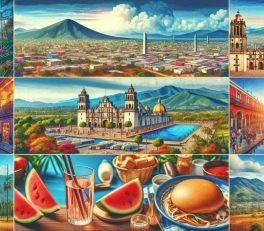
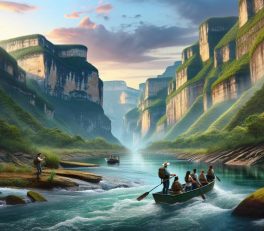
Durango is one of the northern states of Mexico, its main cities being Victoria de Durango, its capital, Gomez Palacios and Lerdo. It is bordered by the states of Coahuila, Zacatecas, Nayarit and Sinaloa. Durango is a rugged state encompassing both high deserts and mountains, plenty of forested and agricultural land and a richness of silver and other minerals. One of the areas of most mystique is a desert area known as the “Zona de Silencio” or Zone of Silence, located near Ceballos and the northern border of Durango with Chihuahua, an area of frequent meteorite activity where sound, radio and magnetic waves seem not to travel or penetrate and where strange phenomena are said to have been recorded by some.
Durango, both state and capital, have claim to fame both for the preponderance of scorpions, which can be found frozen in clear resins and plastics in keychains, decorative tiles, belt buckles and every other conceivable souvenir product imaginable, and the film sets constructed in the town of Chupaderos and other localities in the vicinity of Durango city, in which well over one hundred productions, many of them Westerns, have been brought to the screen over the course of several decades. Durango came to be known as the “Mexican Movieland” and the roster of films that used the Durango area as locations includes A Man Called Horse, El Topo, Cahill – United States Marshal, Old Gringo, Revenge and Fat Man and Little Boy.
Every year Victoria de Durango is host the Durango National Fair, or Feria Nacional. This takes place in July and features regional dances and music, religious processions in commemoration of Our Lady of Refuge (Nuestra Señora del Refugio), cultural activities and fireworks.
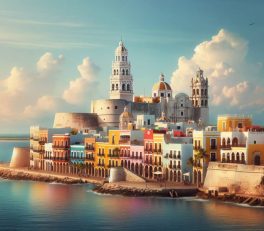
There are a number of impressive churches, museums and colonial structures in the capital city that feature some lovely colonial accents and fine wrought ironwork.
The Cathedral (Catedral Basilica Menor), located on Avenida 20 de Noviembre, has two stately bell towers with baroque overtones and inside are displayed a number of sculptures and paintings. The Cathedral can be visited from 8 a.m. to 7 p.m. daily.
The 18th C. Casa del Conde del Valle de Suchil (House of the Count of Valle de Suchil) is situated between Francisco I. Madero and 5 de Febrero streets and is open to visitors from 9 a.m. through 5 p.m., Monday through Friday.
The Templo de San Agustin (Saint Augustine´s Temple) is located on Avenida 20 de Noviembre and Hidalgo Streets and is open to the public from 8 a.m. to 7 p.m.
Durango´s Palacio de Gobierno, or Government Palace, is on 5 de Febrero street and features balconied patios, stately arches and murals painted by Francisco Montoya de la Cruz. Visiting hours are 9 a.m. to 6 p.m.
The Universidad Juarez de Durango on Constitution was once the old Jesuit college. Its central patio and gardens are surrounded by arches and columns. It can be visted from 8 a.m. to 7 p.m. daily.
The Durango Cultural Institute (Instituto Cultural Durango) encompasses a number of archaeological and historical museum displays including the Museum of the Revolution and the Rafael Trujjillo Film Museum. It is located on Av. 16 de Septiembre No. 130 and is open Tuesday through Friday from 9 a.m. to 6 p.m. and on weekends from 10 a.m. to 6 p.m.
The history of Durango is the theme of the Museo Regional de Durango in the Casa del Aguacate (Avocado House), on Victoria 100 Sur. It also houses a collection of paintings by Miguel Cabrera. Hours are 9 a.m. to 3:45 p.m. from Tuesday through Saturday and 4 to 8 p.m. on Sundays.
The Museum of Popular Cultures (Museo de las Culturas Populares) presents a colorful and interesting display of crafts and local culture and is open from Tuesday through Sunday, 9 a.m. to 6 p.m. Location: Calle Juarez 302 Norte, Durango.
The Archaeological Museum is situated on Calle Zaragoza and features archaeological artifacts from all over the state. It is open from 10 a.m. to 6 p.m. Tuesday through Saturday and 10 a.m. to 7 p.m. on Sundays.
For more information see:
- “Durango.” Wikipedia, The Free Encyclopedia. 20 Nov 2009, 01:49 UTC. 14 Dec 2009 <http://en.wikipedia.org/w/index.php?title=Durango&oldid=326848825>.
- http://www.visitmexico.com/wb/Visitmexico/Visi_Durango
- The Durango Film Commission: http://filmcommissiondurango.com/
(1) Durango Cathedral Photo Attribution: http://www.flickr.com/photos/omurillo/ / CC BY-SA 2.0


![Reblog this post [with Zemanta]](http://img.zemanta.com/reblog_c.png?x-id=e4b24e12-8891-49d6-85e4-71ff3c77699e)