Morelia, Michoacan, Mexico

Capital of Michoacan, Mexico

Morelia cathedral spires

Morelia cathedral spires

Morelia — founded under the name of Valladolid by Mexico’s first Viceroy, Antonio de Mendoza, in the early 1500’s and renamed in 1828 — is the capital of the state of Michoacan. It is located at 1,950 meters above sea level in a central highland valley between the large centers of Guadalajara and Mexico City, each accessible by super highway at a driving distance of about 6 hours in either direction.

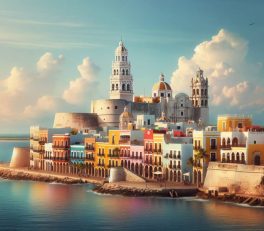
Morelia is a beautiful colonial city in the highlands of Michoacan. The quaint air of its city center with its fabulous architecture, stone arches over series of outdoor restaurants and bars that overlook the town square, the cathedral, parks and old world atmosphere and culture, make for a wonderfully enjoyable yet restful stay.

The streets of the downtown area are highly walkable with many instances of rich colonial architecture on all sides, so take along a good, sturdy pair of walking shoes.

Since 2003, the city has hosted, at the beginning of October of every year, the Morelia International Film Festival (Festival Internacional de Cine de Morelia — FICM) to promote outstanding new Mexican and international filmmakers.  Among those who have attended the festival as special guests have been such film notables as Werner Herzog, Gus Van Sant, Manoel de Oliveira, Stephen Frears, Bertrand Tavernier and Héctor Babenco.

Morelia also has the distinction of hosting, since 1989, the the annual Festival Internacional de Música de Morelia Miguel Bernal Jimenez every November, in celebration and promotion of classicial music studies and performers.

Reserve your Morelia hotel securely on-line. Click here

Things to do and see in Morelia

Plaza de Armas o de los Mártires – Morelia’s main square and heartbeat of the city was planned out between 1541 y 1546 by the Spanish. It’s tree-shaded benches and walkways are surrounded by colonial buildings and arched galleries that are home to numerous restaurants, shops and news stands.

Bosque Cuauhtémoc – South of the Aqueduct is a wooded recreational park known as the Bosque Cuauhtemoc, or Cuauhtemoc Forest, wherein are located the Museums of Natural History and Contemporary Art.

Mercado de Dulces y Artesanias – Candy and Crafts market – Located to the west of the Colegio de Jesuitas, selling all kinds of regional sweets and crafts.

Benito Juarez Zoo – Morelia’s zoo holds the largest collection of species in the country. Open Monday to Friday 10 am to 5 pm; Saturdays, Sundays and holiday 10 am to 6 pm.

Planetarium – 164 projectors reproduce the movements of the stars on the planetarium’s 20 meter high dome. Showings on Fridays and Saturdays at 7 pm; Sundays at 6:30 pm.

Museums

  • Mask Museum – Templo y Ex-convento del Carmen – construction was begun in 1593 and carried on throughout the 17th, 18th and 19th centuries. It underwent restoration from 1974 and 1979 and was converted into the Morelian Cultural Institute for workshops and exhibits. It is home to the Mask Museum, which is open to the public Mon-Fri 10 am to 2 pm and 4 pm to 8 pm. Sat-Sun 11 am – 2 pm and 3 pm to 6 pm.
  • Museo Casa de Morelos – This mansion was built in 1758 and purchased by Morelos in 1801. It is now a museum displaying historical artifacts and documents. Open daily 9 am – 7 pm
  • Museum of Colonial Art – Located in the building which housed Morelias first printing press in 1821. The museum exhibits, among other artifacts, figures of Christ made of cornstalk paste from the Evangelization era. Hours: Monday-Friday 10 am to 2 pm and 5 pm to 8 pm; Saturday and Sunday 10 am to 2 pm and 4:30 pm to 7 pm.
  • Museum of Contemporary Art Alfredo Zalce – Located in Bosque Cuauhtemoc. Open Tues-Sat 10 am to 14 pm and 4 pm to 8 pm. Sundays, 10 am to 3 pm
  • Museum of Geology and Mineralogy – on the University campus. Hours: Monday-Friday 8 am to 3 pm.
  • Museum of Natural History. Open daily 10 am to 6 pm.
  • Regional Michoacan Museum – House in an ornate building dating from 1772, The Regional Museum was established in 1886 and is one of the country’s oldest. Open Tues-Sat 9 am to 7 pm; Sundays 9 am to 2 pm.
  • State Museum – holds sections on Archaeology, History and Ethnology. Open Mon-Fri 9 am to 2 pm and 4 pm to 8 pm. Saturdays, Sundays and holidays from 9 am to 2 pm. and 4 pm to 7 pm.

Colonial Architecture of Morelia

Morelia’s historical center is a dream-come-true for lovers of colonial architecture, with its myriads of elaborately decorated and stunning buildings an structures. Some of the most notable are:

  • Aqueduct – Its 253 baroque arches were constructed in 1785 to provide drinking water to Morelia.
  • Antigua Alhóndiga – Built 1774 as a city granery, today the Alhondiga houses the Civil Courts
  • Antigua Casa de Gabriel García Obeso – Constructed in the late 18th C with neoclassic exterior and baroque interiors. Now occupied by Bancomer.
  • Antigua Casa del Diezmo – House of the Tithe – This baroque building was built in 1750 to serve as the offices and storeroom for the tithe. Today it houses Banamex.
  • Antiguo Hospital de los Juaninos – This elaborate building, constructed in 1865 as the Episcopal House, was used at the beginning of the 18th C. as a hospital. Today it is owned by Bital Bank.
  • Casa Natal de Morelos – birthplace of Morelos – lovely baroque style house constructed at the end of the 19th C. on the site of the house in which José María Morelos y Pavón was born. The house was remodelled in 1964.
  • Cathedral – Morelia’s stately, rose-colored Cathedral was constructed between 1660 and 1744 and sits as its centerpiece, right off the city’s main plaza.
  • Colegio de San Nicolas de Hidalgo – Neoclassical construction of the 16th C.
  • Courthouse – decorative structure with an elaborate, frenchified facade.
  • Federal Palace – constructed in the 18th C. as a convent, it has been home to the offices of the Federal Government since 1935.
  • Government Palace – built between 1760 and 1770. Since 1867 has served as the headquarters of the executive branch of the State. Holds murals depicting highlights of the history of Mexico, painted by Michoacan artist, Alfredo Zalce.
  • Iglesia de Capuchina – Baroque styled Capuchin church built between 1680 and 1737 to shelter the daughters of the regional tribal chiefs.
  • Iglesia y Convento de San Francisco (The House of Crafts) – Construction was begun by the Franciscans in 1531 on this, the first convent of Valladolid. It now houses the Michoacan House of Crafts. Open daily 9 am to 3 pm and 5:30 to 8 pm.
  • Municipal Palace – built at the end of the 18th century as for the tobacco industry with an octagonal courtyard, this baroque building has been the Municipal Palace, or town hall, since 1859.
  • Palacio Clavijero – This Baroque-style building dating from the middle of the 17th C. has housed the Michoacan Congress since 1824 and is one of the cities most important monuments.
  • Public Library – Baroque style construction of the 17th C. originally the Temple of the Company of Jesus.  Converted to a Public Library in the 30’s.
  • Santuario de Guadalupe and Ex Convent of San Diego – constructed in the early 1700’s, it now houses the Faculty of Law of the University of Michoacan.
  • Templo de la Cruz – Simple structure erected between 1680 and 1690.
  • Templo de las Monjas – baroque-style building from the years 1729 to 1737.
  • Templo de los Agustinos – 16th C. building with Gothic influence
  • Templo y Conservatorio de Musica de las Rosas – The building which has housed the Conservatory of Music since the 40’s, as well as the Morelia Children’s Choir, dates from the 18th
Share and Enjoy:
  • Print
  • Facebook
  • Google Bookmarks
  • email
  • StumbleUpon
  • RSS
  • Twitter

Leave a Reply