Oaxaca Street
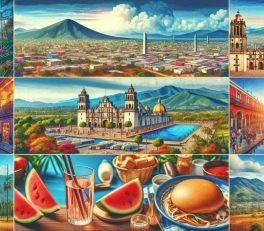
The name “Oaxaca” (wah-HAH-kah) stems from the náhuatl word Huaxyacac, meaning “on the nose of the gourds”. The state, founded on February 3, 1824, lies along the southeast region of the Mexican Pacific, bordering the states of Puebla and Veracruz to the north, Chiapas to the east and Guerrero to the west. It is the 5th largest state of the Mexican Republic.
Oaxaca is divided into 570 municipalities, with a total population of some 3.3 million inhabitants, of which over two million are of indigenous groups. It is a ruggedly mountainous state with isolated valleys that were settled over the generations by diverse tribes which have preserved an astounding degree of their individual cultures and languages. Sixteen distinct ethnolinguistic groups are represented by the population: the Amuzgo, Chatino, Chinanteco, Chocho, Chontal, Cuicateco, Huave, Ixcateco, Mazateco, Mixe, Mixteco, Náhuatl, Triqui, Zapoteco, Zoque and the Popoloca.
The Central Valley in the interior of the state offers the visitor numerous small villages whose inhabitants specialize in regional arts and crafts such as hand-woven rugs, black pottery, colorful, carved wooden figurines, shawls and other textiles. Here also is a wealth of precolumbian archaeological sites and ceremonial centers such as Monte Alban and Mitla.
Places of interest in Oaxaca
Azompa
A village of expert potters located a short distance from Oaxaca City. Glazed green and unglazed beige and red clay pottery is made by hand by the majority of the villagers. One of the typical forms the unglazed pottery figures take is that of animals such as deer and sheep. The bodies are hollow and the exterior of the animal is textured. Water is placed in the hollow interior and chia seeds are sprinkled onto the textured “hide”. Within a couple of days, these seeds will sprout, fed by the moisture that seeps through the clay from the water inside. You soon end up with a wonderfully fuzzy green-coated animal!
Huatulco
A new ecological resort area consisting of a series of gorgeous bays on the Pacific Coast.
Mazunte
A small beachside community on the Pacific coast of Oaxaca near Puerto Angel, home to the Centro Mexicano de la Tortuga (Mexican Turtle Center) and a natural cosmetics factory.
Mitla
Mitla’s quaint, narrow and colorful streets are home to textile merchants as well as to a great number of Mezcal producers and vendors. Visit the church and neighboring archaeological site and find out how Mezcal is made.

Monte Alban ruins
Monte Alban Ruins
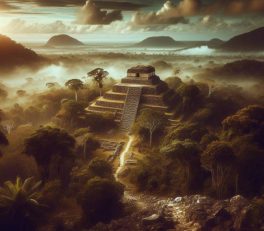
Five miles to the west of Oaxaca City lie the spectacular Monte Alban ruins, perched on a mountaintop high above the surrounding valleys.
Oaxaca City
Capital of the State of Oaxaca, Oaxaca city is rich in colonial architecture as well as native crafts and culture.
Ocotlan
Located a short jaunt outside of Oaxaca City along the Pochutla Highway, Ocotlan offers a Friday market where one can buy petates (woven straw mats), embroidered dresses from San Antonino, regional pottery and a miscellany of household goods and food products.
Puerto Angel and Zipolite
A quaint and quiet fishing village on the Pacific Coast, with Zipolite beach nearby.
Puerto Escondido
A surfer’s paradise, Zicatela Beach just outside Puerto Escondido is known as the “Mexican Pipeline” and is a surfing spot favored by wave riders from all over the world.
San Bartolo Coyotepec
Located 15 km south of Oaxaca City, San Bartolo Coyotepec is known for its production of a unique black clay pottery. The technique involves the smoking and careful stone polishing the pots and the firing of them at a relatively low temperature, producing pottery with a rich, black sheen.
Santa Maria del Tule
Along Highway 190 on the way to Mitla, located next to this small town’s church, is an enormous Ahuehuete tree (Mexican Bald Cypress). The Tule tree’s height and girth are both over 130 feet each, and it is calculated to be over 2,000 years old. An incredible specimen.
Tehuantepec
The charming city of Tehuantepec, on the Isthmus of the same name, is a town of beautiful, stately and strong, local women (Tehuanas) of Zapotec extraction, and is known for its elaborate hand-embroidered traditional dresses, ceramics and gold jewelry.
Teotitlan del Valle
A small village in the hills known for its production of fine, hand-woven, woolen rugs. Visit the local museum, Balaa Xtee Guedchi Gula
Oaxaca’s Climate
There is fair amount of variation between the weather conditions in the high, arid central valleys of Oaxaca and on its humid, balmy coastline, separated by the Sierra Madres, whose highest peak stands at 12,205 feet above sea level.
Mist through the trees on the Coastal highway of OaxacaThe central plains and valleys have an average high temperature of 34º C (93º F) and lows of 11º C (41º F), while the coast averages highs of 36º C(96º F) and lows of 25º C (77º F). Evenings and early mornings in the hilly central regions can be quite chilly, making necessary the use of jackets, sweaters and shawls for comfort.
Rainy season, as in most of Mexico, is May to September, with an average annual rainfall in the coastal areas of 31-1/2″ and in the central valleys, of 29-1/2″.
Related articles by Zemanta
- Listening to the melodies of Mexico in Oaxaca (nationalpost.com)
- Oaxaca Offers A Unique Mexican Vacation (abcnews.go.com)